

The Power of Compounding: How It Can Transform Your Financial Future
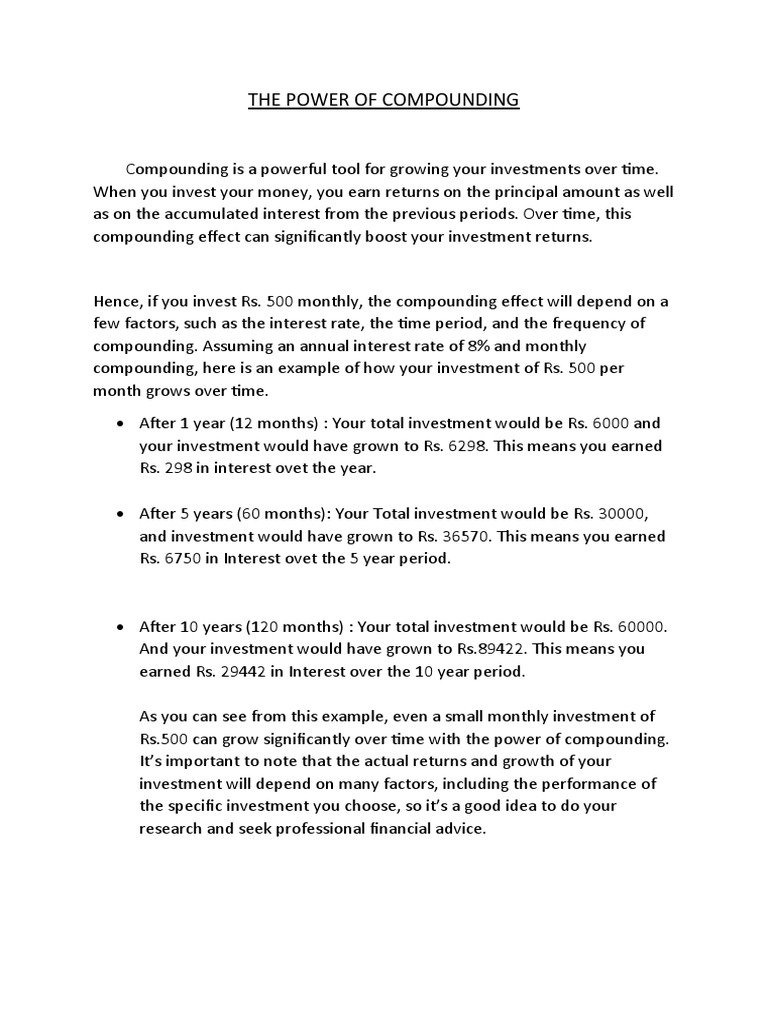
The concept of the power of compounding is one of the most fundamental and transformative ideas in personal finance. It’s not just about earning interest on your money; it’s about earning interest on the interest you’ve already earned. This snowball effect can significantly boost your wealth over time, making it a cornerstone of long-term financial planning. Whether you’re saving for retirement, building an emergency fund, or investing in the stock market, understanding how compounding works can help you make smarter financial decisions.
What Is Compound Interest?
Compound interest is a financial mechanism where the interest earned on an investment is reinvested, allowing you to earn more interest in subsequent periods. Unlike simple interest, which is calculated only on the original principal amount, compound interest grows exponentially because it includes both the principal and the accumulated interest.
For example, if you invest $1,000 at a 10% annual interest rate, after the first year, you’ll have $1,100. In the second year, the interest will be calculated on $1,100, giving you $1,210, and so on. Over time, this compounding effect becomes increasingly powerful, especially when you start early and maintain consistent contributions.
How Compounding Works

To understand how compounding works, let’s break it down step by step:
- Initial Investment: You start with a certain amount of money, known as the principal.
- Interest Calculation: At the end of each period (yearly, monthly, etc.), interest is calculated based on the current balance.
- Reinvestment: The interest earned is added back to the principal, increasing the total amount.
- Repeat: This process repeats for each compounding period, leading to exponential growth.
This cycle continues, and the longer you stay invested, the more significant the impact of compounding becomes. Even small amounts invested regularly can grow into substantial sums over decades.
Key Factors That Influence Compounding
- Time: The longer your money is invested, the more time it has to grow through compounding.
- Rate of Return: Higher returns lead to faster growth, but even modest rates can produce impressive results over time.
- Compounding Frequency: More frequent compounding (e.g., monthly instead of annually) can result in slightly higher returns.
- Regular Contributions: Adding to your investment periodically enhances the compounding effect.
The Rule of 72
One of the simplest ways to estimate how long it takes for an investment to double is the Rule of 72. This rule states that you can divide 72 by the annual interest rate to get an approximate number of years it will take for your investment to double.
For instance:
– At 6% interest, your money will double in about 12 years (72 ÷ 6 = 12).
– At 8% interest, it will double in about 9 years (72 ÷ 8 = 9).
While the Rule of 72 is an approximation, it’s a useful mental shortcut for quickly assessing the potential of different investments.
Real-World Applications of Compounding

The power of compounding isn’t just theoretical—it has real-world implications that affect everyone’s financial future. Here are a few examples:
Retirement Savings
Retirement accounts like 401(k)s or IRAs benefit greatly from compounding. For example, if you start investing $200 a month at age 25 and earn an average 7% return, you could accumulate around $1.37 million by age 65. Starting later, even with larger contributions, may not yield the same results due to the reduced time for compounding.
High-Yield Savings Accounts
Even low-interest savings accounts can benefit from compounding. A $20,000 emergency fund in a high-yield savings account with a 4.5% APY would earn approximately $900 in the first year. That interest is then added to the balance, creating a growing base for future earnings.
Investment Portfolios
Investment portfolios with regular contributions can harness the power of compounding. By consistently adding to your portfolio, you allow each contribution to benefit from the compounding effect over time, potentially leading to significant long-term gains.
Why Starting Early Matters
One of the most important lessons in personal finance is that starting early can have a massive impact on your financial future. The earlier you begin investing, the more time your money has to grow through compounding.
Consider three investors who all earn 7% average annual returns:
– Early Erica invests $200/month from age 22 to 32 (10 years), then stops. She ends up with about $338,000 at age 65.
– Late Larry invests $200/month from age 32 to 65 (33 years). He ends up with about $280,000 at age 65.
– Consistent Chris invests $200/month from age 22 to 65 (43 years). He ends up with about $618,000 at age 65.
Erica started later but still ended up with more than Larry, highlighting the importance of time in compounding.
Conclusion
The power of compounding is a game-changer in personal finance. It allows your money to grow exponentially over time, turning small investments into substantial wealth. Whether you’re saving for retirement, building an emergency fund, or investing in the stock market, understanding and leveraging the power of compounding can transform your financial future. Start early, stay consistent, and let time work in your favor.